





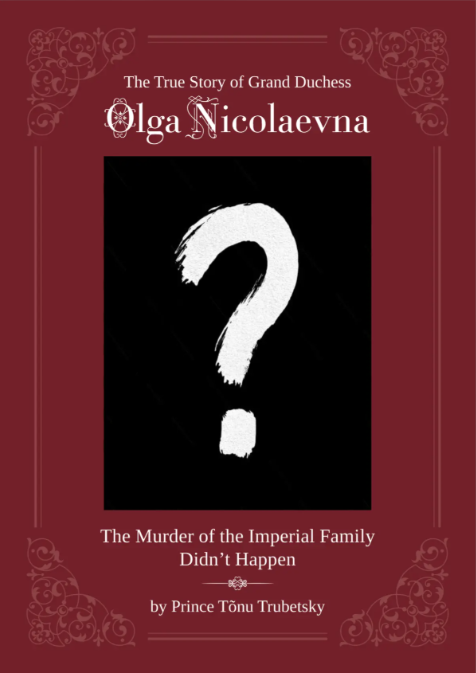

The True Story of Grand Duchess Olga Nicolaevna
39,50 €
THE TRUE STORY OF GRAND DUCHESS OLGA NICOLAEVNA: THE MURDER OF THE IMPERIAL FAMILY DIDN’T HAPPEN
By Prince Tõnu Trubetsky
“Commandant Lasies, even if the Tzar and the Imperial Family are alive, it is necessary to say that they are dead!”
Robert Wilton to Commander Joseph Lasies, on the platform of the railway station at Ekaterinburg, 18 May 1919.
«Мир никогда не узнает, что мы сделали с ними.»
“The world shall never know what we did to them.”
Pyotr Lazarevich Voikov, in the company of ladies at Ekaterinburg, probably 23 July 1918.
For more than a century, the world has believed that it knows what happened on the night of 17 July 1918.
It is said that, in the cellar of the Ipatiev House at Ekaterinburg, the Bolsheviks put to death Nicholas II, Alexandra Feodorovna, their five children, and their faithful servants. Their deaths were declared final. Their graves were “discovered.” Their identities were “confirmed” by DNA. The case was considered closed.
But what if the case was closed too soon?
What if the most famous execution of the twentieth century never took place at all?
A DISCOVERY THAT CHANGES EVERYTHING
Prince Tõnu Trubetsky did not begin as a revisionist historian. He began as the keeper of a family story—a story too extraordinary to be passed on lightly.
As a child, he heard whispers of a truth that had never been written in the schoolbooks. A truth preserved in private conversations, guarded photographs, and fragments of testimony carried across frontiers and from one generation to another.
Years later, he found Olga. Not a legend. Not an impostor. Not a myth.
Grand Duchess Olga Nicolaevna—alive after 1918.
What followed was not conjecture, but documentation: photographs taken after the alleged execution; suppressed testimonies; a trail of movements through Perm, Livadia, Constantinople, Munich, and beyond.
Any one of these circumstances might be dismissed as insignificant. Taken together, however, they form a picture far more difficult to ignore.
And Olga was not alone.
THE SURVIVAL OF THE DYNASTY
If Olga survived, the accepted narrative collapses.
If she survived, the story connected with the Ipatiev House is not a tale of execution, but of disappearance.
If she survived, the political meaning of 17 July 1918 is utterly transformed.
This book presents evidence and ORIGINAL PHOTOGRAPHS (!) indicating that the Imperial Family survived intact. That the deaths announced to the world were part of a deception.
Behind the story of the events at the Ipatiev House lies another history: secret removals, false reports, wrongly identified remains, and a century of silence.
WHY DOES THIS MATTER NOW?
The execution of the Romanovs became one of the foundational myths of the twentieth century—the symbol of the revolution's irreversibility.
To challenge it is not merely to reconsider a historical incident, but to re-examine an event which helped shape modern Europe.
This is not romantic nostalgia.
This is investigation.
Drawing upon contradictions in the forensic evidence, interrogation records, fragments from the archives, and photographic evidence (!), Prince Trubetsky reconstructs the true course of events—a course which leads far beyond the semi-basement of the Ipatiev House and Ekaterinburg, into the hidden corridors of post-imperial Europe.
QUESTION THE LIE. UNCOVER THE TRUTH.
What really happened to the Imperial Family in 1918?
Who lies in the graves shown to the world?
And why was it so important that the world should believe that they were dead?
The answers begin here.
SUURVÜRSTITAR OLGA NIKOLAJEVNA TÕELINE LUGU: KEISERLIKU PEREKONNA MÕRVA EI TOIMUNUD
Autor: vürst Tõnu Trubetsky
«Komandör Lasies, isegi kui Tsaar ja Tsaari perekond on elus, tuleb öelda, et nad on surnud!»
Robert Wilton komandör Joseph Lasies’le Jekaterinburgi raudteejaama perroonil 18. mail 1919.
«Мир никогда не узнает, что мы сделали с ними.» — «Maailm ei saa kunagi teada, mida me nendega tegime.»
Pjotr Lazarevitš Voikov (daamide seltskonnas Jekaterinburgis, tõenäoliselt 23. juulil 1918).
Rohkem kui sajandi vältel on maailm uskunud, et teab, mis juhtus ööl vastu 17. juulit 1918.
Räägitakse, et Jekaterinburgis asuva Ipatjevi maja keldris hukkasid bolševikud Nikolai II, Aleksandra Fjodorovna, nende viis last ja ustavad teenrid. Nende surm kuulutati lõplikuks. Nende hauad «leiti üles». DNA «kinnitati». Juhtum loeti lahendatuks.
Aga mis siis, kui juhtum suleti liiga vara?
Mis siis, kui 20. sajandi kuulsaimat hukkamist ei toimunudki?
AVASTUS, MIS MUUDAB KÕIKE
Vürst Tõnu Trubetsky ei alustanud revisionistliku ajaloolasena. Ta alustas kui perekonnaloo hoidja – loo, mis oli liiga erakordne, et seda kergekäeliselt edasi rääkida. Juba lapsena kuulis ta sosinaid tõest, mida ei oldud kunagi õpikutesse kirja pandud. Tõest, mida hoiti alal eravestlustes, valvatud fotodel ja üle piiride ning põlvkondade kantud tunnistuste kildudes. Aastaid hiljem leidis ta Olga üles.
Mitte legendi. Mitte teeskleja. Mitte müüdi.
Suurvürstitar Olga Nikolajevna – elus pärast 1918. aastat.
Sellele järgnes mitte oletus, vaid dokumentatsioon: fotod, mis olid tehtud pärast väidetavat hukkamist; mahavaikitud tunnistused; liikumisteekond läbi Permi, Livadia, Konstantinoopoli, Müncheni ja sealt edasi. Iga üksikut asjaolu võiks pidada tähtsusetuks. Koos moodustavad need aga tervikpildi, mida on palju raskem eirata. Ja Olga ei olnud üksi.
DÜNASTIA ELLUJÄÄMINE
Kui Olga jäi ellu, siis senine narratiiv variseb kokku. Kui ta jäi ellu, pole Ipatjevi majaga seotud lugu mitte jutustus hukkamisest, vaid kadumisest. Kui ta jäi ellu, muutub 1918. aasta 17. juuli poliitiline tähendus täielikult.
See raamat esitab tõendeid ja ALGUPÄRASEID FOTOSID (!) selle kohta, et Tsaariperekond jäi tervikuna ellu. Et maailmale teatatud surmad olid osa pettusest. Ipatjevi maja sündmuste loo taga peitub teistsugune ajalugu: salajased ümberpaigutamised, võltsteadaanded, valesti tuvastatud säilmed ja sajandipikkune vaikus.
MIKS ON SEE PRAEGU OLULINE?
Romanovite hukkamisest sai 20. sajandi alusmüüt – revolutsiooni pöördumatuse sümbol. Selle vaidlustamine ei tähenda ainult ajaloolise seiga, vaid ühe tänapäeva Euroopat kujundanud sündmuse uuesti läbivaatamist. See pole romantiline nostalgia. See on uurimistöö.
Toetudes kohtuekspertiisi vastuoludele, ülekuulamisprotokollidele, arhiivikatkenditele ja fototõenditele (!), rekonstrueerib vürst Trubetsky tegeliku sündmuste käigu – sellise, mis viib kaugele Ipatjevi maja poolkeldrikorruselt ning Jekaterinburgist sügavale postimperiaalse Euroopa varjatud koridoridesse.
VAIDLUSTA VALE. AVALIKUSTA TÕDE.
Mis Tsaariperekonnaga 1918. aastal tegelikult juhtus?
Kes puhkavad maailmale näidatud haudades?
Ja miks oli nii tähtis, et maailm usuks nende surma?
Vastused algavad siit.

Saadavus kauplustes

Detailid

 Võrdle suurust
Raamatu suurus

Arvutus põhineb keskmisel lugemiskiirusel, kus 200-250 sõna lugemiseks kulub 2 minutit.
 Eesti suurim raamatumüüja
 Eripakkumised püsiklientidele
 Tasuta tarne tellimustele üle 39 €
 Kiireim tarne alates 2 tunnist
Copyright © 2026 www.rahvaraamat.ee. Kõik õigused kaitstud.
Rahva Raamat AS, 10421903, Telliskivi 60/2 (I-hoone), Tallinn, 15073, Eesti